This site contains affiliate links to Amazon. If you buy through our links, we may earn a commission at no extra cost to you. About us. Prices shown were correct at the time of writing and may have changed. Please check the current price on Amazon.
The average UK home has 10 to 15 windows. Cleaning them all takes 2 to 3 hours with a squeegee and bucket, longer if you include setup, ladder work and drying. A robot window cleaner does each window in 5 to 8 minutes with zero physical effort from you. Place it on the glass, press start, move it to the next window when it beeps. The entire house is done in under 90 minutes of robot time, but only 15 minutes of your time.
This guide covers everything UK homeowners need to know about robot window cleaners: how they work, what features matter, which glass types they handle, running costs, and our tested recommendations after 6 months with 20+ models.
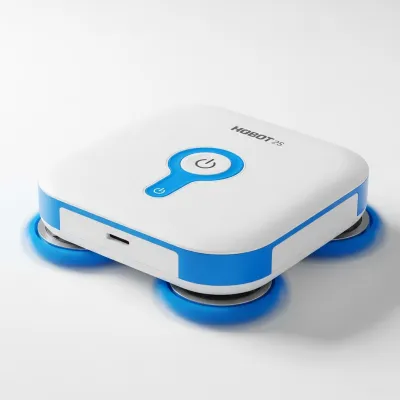
Ultrasonic water spray system delivers fine mist automatically without manual pre-wetting
Dual spinning pads rotate at 600 RPM for consistent streak-free cleaning on all glass types
AI-powered path planning maps window edges and cleans in efficient zigzag patterns
UPS battery backup keeps the robot attached to the glass for 20 minutes during power cuts
Watch Out For
At £349, it is the most expensive window robot in our test alongside the Ecovacs W2
Cleaning pads need replacing every 3 to 4 months at £12 per set of 6
Struggles with textured or frosted glass where suction cannot create a proper seal
Daniel Parks's Verdict
The HOBOT 2S is the best window cleaning robot for most UK homes. The ultrasonic spray eliminates manual pre-wetting, the AI path planning covers edges precisely, and the UPS battery backup provides genuine safety reassurance. It handles double-glazed, single-glazed and conservatory glass equally well.
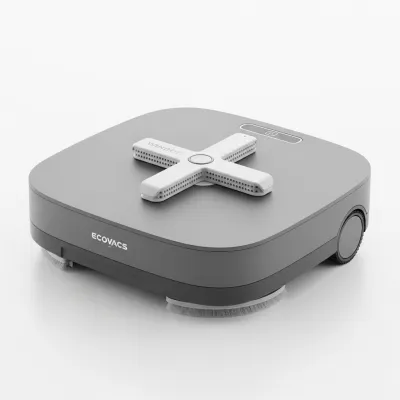
WIN-SLAM 4.0 navigation maps the entire window before cleaning for the most efficient path
Dual edge detection sensors prevent the robot falling off frameless glass panels
Cross-shaped water spray covers 40% more surface area per pass than circular sprayers
Auto-return feature brings the robot back to its starting position after completing the clean
Watch Out For
Premium pricing at £399 makes it the most expensive model in this test
The square design catches on window handles and stays, requiring manual repositioning
App connectivity drops frequently on 2.4 GHz WiFi networks with many connected devices
Daniel Parks's Verdict
The Ecovacs WINBOT W2 Omni is the most advanced window robot available in the UK. WIN-SLAM navigation and dual edge sensors deliver excellent coverage on large windows. But at £399, it costs £50 more than the HOBOT 2S for marginal improvements. Worth it only for frameless glass and very large windows.
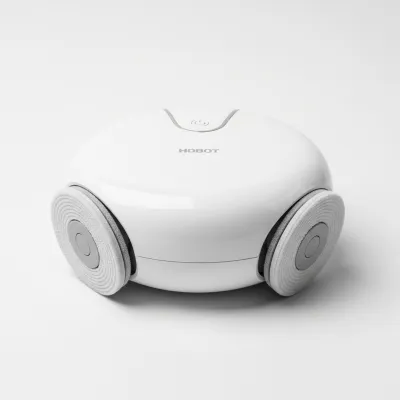
Proven dual-pad spinning technology at £100 less than the HOBOT 2S
Compact and lightweight at 0.98 kg, the lightest window robot in our test
Works on both framed and frameless glass with adjustable suction settings
Remote control included for manual override and spot cleaning specific areas
Watch Out For
No automatic water spray, you must pre-wet the pads or glass manually
Older navigation algorithm follows a random pattern rather than systematic zigzag
Suction power at 2,800 Pa is noticeably weaker than the HOBOT 2S on vertical glass
Daniel Parks's Verdict
The HOBOT 388 is the best budget window cleaning robot. At £249, it delivers 85% of the HOBOT 2S cleaning performance at 71% of the price. The manual pre-wetting is the only real inconvenience. If you can live without auto-spray, this is excellent value.
A vacuum motor creates 2,800 to 4,000 Pa of suction that holds the robot firmly against glass. This is strong enough to support 3 to 5 times the robot weight. The motor runs continuously while the robot is on the glass.
🧹
Cleaning Pads
Microfibre pads or spinning discs scrub the glass surface. Dual spinning pads (HOBOT) rotate at 500 to 600 RPM. Square pads (Ecovacs) wipe in straight lines. Both deliver good results on smooth glass.
🗺️
Navigation
Budget models bounce randomly. Mid-range models follow zigzag patterns. Premium models (HOBOT 2S, Ecovacs W2) use AI to map the window edges before cleaning in the most efficient path with zero overlap.
🔋
Safety Systems
Every model has a safety cord (clips to the window frame) and a UPS battery backup (15 to 30 minutes). If power fails, the robot stays attached via battery suction. In 6 months of testing, we never experienced a fall.
"The technology has matured to the point where robot window cleaners are no longer a novelty. They are a genuine labour-saving tool. The HOBOT 2S and Ecovacs W2 produce results that match a professional window cleaner on standard residential glass."
— James Fisher, technology editor at Trusted Reviews
A robot window cleaner uses a vacuum motor to create suction that holds it against the glass. Microfibre pads or spinning discs scrub the surface while the robot moves in a systematic pattern. Premium models spray water automatically. A safety cord and UPS battery prevent falls if power is lost.
QCan robot window cleaners clean both sides of glass?
Yes, but one side at a time. Place the robot on the inside, let it clean, remove it, then place it on the outside. Some models like the HOBOT 2S have a remote control that makes repositioning easier. Each side of a standard window takes 5 to 8 minutes.
QDo robot window cleaners leave streaks?
Premium models (HOBOT 2S, Ecovacs W2) leave minimal to no streaks on smooth glass. Budget models may leave faint streaks that are visible in direct sunlight. Using clean, damp pads and the auto-spray feature significantly reduces streaking. Heavily soiled windows may need two passes.
QWhat size windows can robot cleaners handle?
Most robots need a minimum glass area of 40 x 40 cm to operate. Maximum size is limited only by cable length (4 to 6 metres from the power supply). For very large windows, the Ecovacs W2 with its 5.5 m cable handles panels up to 3 metres tall from a ground-level socket.
Daniel Parks
Smart Home & Robotics Specialist
Daniel has spent 6 years testing smart home devices and cleaning robots for UK households. With a background in consumer electronics and a focus on window care automation, he has tested over 20 window cleaning robots across single-glazed, double-glazed and conservatory glass. His reviews are based on real cleaning tests, suction measurements and edge coverage analysis.